

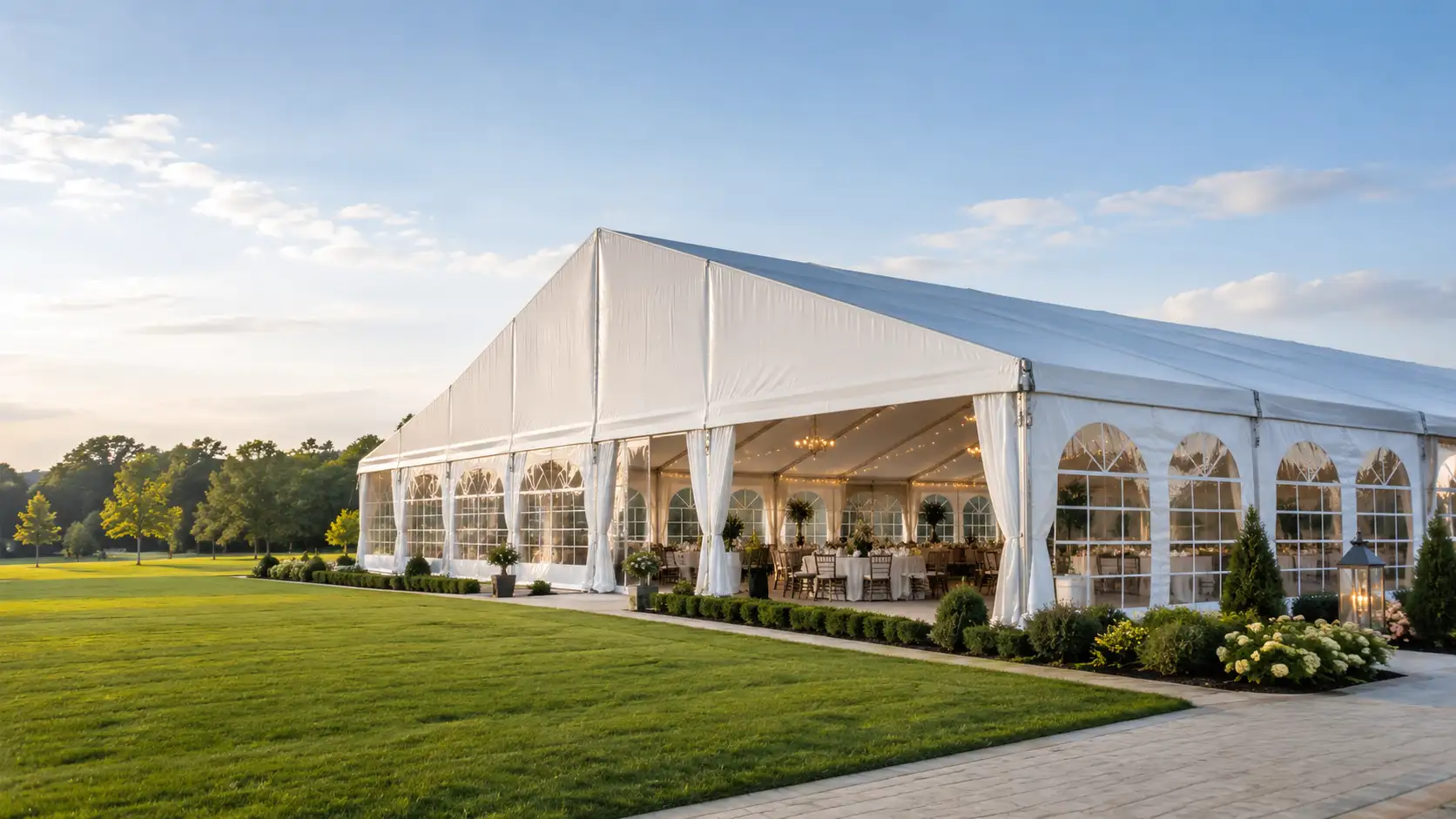
Large event tents are widely used for celebrations, trade shows, sporting events, music festivals, corporate functions, temporary storage, and large outdoor gatherings. They offer fast installation, flexible dimensions, efficient space utilization, and a wide range of customization options.
However, ordering a large event tent involves much more than simply choosing its width and length. The tent span, installation site, expected service period, local climate, interior layout, and accessories can all affect the final design and total project cost.
To help buyers plan their projects more effectively, here are 10 important questions to answer before ordering a custom large event tent.
1. What Will the Tent Be Used For?
The first step is to clearly define the purpose of the tent.
Different events have different requirements for structure, appearance, access, and interior configuration. For example:
- Exhibition tents focus on efficient floor space and brand presentation.
- Wedding tents place greater emphasis on appearance, natural light, and interior decoration.
- Sports tents require large, unobstructed interior spaces.
- Music festival tents may need stages, lighting systems, and sound equipment.
- Temporary storage tents require good weather protection, secure enclosure, and convenient vehicle access.
Once the application is clear, the manufacturer can recommend a more suitable structure, material, and configuration.
2. What Tent Size Do You Need?
The correct tent size depends on the number of guests, the event format, and the required functional areas.
For a wedding or banquet, the layout may include dining tables, chairs, a stage, a dance floor, service aisles, and catering areas. For an exhibition, space may be required for booths, reception counters, storage rooms, and emergency exits.
In addition to the width and length, buyers should also consider the side height, peak height, and whether a column-free interior is required.
When requesting a quotation, it is helpful to provide the following information:
- Estimated number of guests
- Type of event
- Table, seating, or booth arrangement
- Stage requirements
- VIP rooms, kitchens, reception areas, or service zones
Based on this information, the manufacturer can recommend a suitable tent size and floor plan.
3. What Type of Surface Will the Tent Be Installed On?
Large event tents can be installed on grass, soil, concrete, asphalt, paved plazas, and other hard surfaces. However, each type of ground requires a different anchoring method.
On grass or soft ground, steel stakes or ground anchors are commonly used. On concrete, asphalt, parking areas, or surfaces where drilling is restricted, expansion bolts, concrete blocks, steel weights, or other ballast systems may be required.
Before ordering the tent, confirm the following:
- Is the site level?
- Is drilling permitted?
- Are there underground pipes, cables, or utility lines?
- Is there sufficient access for trucks, forklifts, or lifting equipment?
- Are there nearby buildings, trees, power lines, or other obstacles?
Accurate site information allows the manufacturer to design a safer and more reliable anchoring system.
4. What Are the Local Wind, Rain, and Snow Conditions?
Large tents are outdoor temporary or semi-permanent structures, so local weather conditions must be considered during the design process.
Wind speeds, rainfall, and snow loads vary by region. Tents installed in coastal areas, high-altitude regions, winter climates, or other demanding environments may require reinforced frames, additional anchoring, or a modified roof structure.
Buyers should provide the project location, intended season of use, and expected installation period.
Wind resistance and load capacity should not be evaluated using a single general figure. They should be assessed according to the tent dimensions, installation method, site conditions, and applicable local requirements.
5. How Long Will the Tent Be Used?
The expected service period affects the choice of structure and materials.
A tent used for a short event lasting only a few days may prioritize fast assembly and dismantling. A tent used for several months or years should place more emphasis on corrosion resistance, fabric durability, drainage, sealing, condensation control, and maintenance.
Tents intended for longer-term use may require:
- Reinforced anchoring systems
- Rainwater drainage systems
- Insulated wall panels or double-layer fabric
- Condensation-control solutions
- Ventilation and climate-control equipment
- Scheduled inspections and maintenance
Providing the expected service period helps the manufacturer recommend a more appropriate solution.
6. What Type of Fabric and Wall System Do You Need?
Large event tents commonly use high-strength coated fabric for the roof and sidewalls. When evaluating the fabric, buyers should consider waterproof performance, flame retardancy, UV resistance, abrasion resistance, and expected service life.
Available wall options may include:
- PVC fabric sidewalls
- Clear PVC walls
- Glass wall systems
- ABS solid walls
- Steel-sheet walls
- Insulated sandwich panels
PVC sidewalls are suitable for many standard events. Clear walls and glass doors can improve the appearance of weddings and exhibitions. Solid or insulated wall panels may be more appropriate for temporary warehouses and long-term installations.
7. Do You Need a Flooring System?
A professional flooring system can improve surface levelness, reduce moisture, and protect the interior from mud, dust, and rainwater.
Common flooring options include wooden platforms, modular flooring, anti-slip flooring, and elevated flooring supported by steel substructures.
Flooring is especially useful when the installation site is uneven or when the event requires a polished and comfortable interior.
When selecting a flooring system, consider the number of guests, equipment weight, stage loads, and whether vehicles need to enter the tent.
8. What Accessories and Interior Systems Are Required?
The tent structure is only one part of a complete event venue. Most large event projects also require accessories and interior systems.
Common options include:
- Lighting systems
- Air-conditioning or heating
- Ventilation equipment
- Flooring and carpets
- Glass doors
- Clear roof panels
- Interior liners and curtains
- Stages and backdrops
- Tables, chairs, and partitions
- Rain gutters and downpipes
- Emergency exits and safety signs
Confirming these requirements during the early planning stage can reduce later modifications and additional costs.
9. Who Will Handle Installation, Dismantling, and Transportation?
Large tents are usually designed with modular components and can be assembled and dismantled repeatedly. However, installation still requires trained personnel, suitable tools, and proper safety procedures.
Before placing an order, confirm:
- Whether installation guidance is included
- Whether on-site installation services are available
- Whether assembly drawings and manuals will be provided
- Whether cranes, forklifts, or lifting platforms are required
- How many workers are needed
- How long installation is expected to take
- Whether the packaging is suitable for sea or land transportation
- How the tent should be dismantled and stored
For export projects, buyers should also confirm package dimensions, container quantities, shipping methods, and installation support at the destination.
10. Does the Supplier Have the Necessary Design and Manufacturing Capabilities?
Large event tents are customized products, so the supplier’s engineering, manufacturing, and quality-control capabilities directly affect the project outcome.
When evaluating a tent supplier, consider the following:
- Does the supplier operate its own factory?
- Does it have structural design capabilities?
- Can it manufacture customized dimensions?
- Does it have stable sources of raw materials?
- Does it follow a complete quality-control process?
- Does it have experience with similar projects?
- Can it provide spare parts and after-sales support?
- Can it provide relevant material or product documentation?
Price is important, but it should not be the only factor. Structural safety, material quality, production capacity, delivery reliability, and after-sales service are equally important.
Conclusion
Ordering a custom large event tent requires careful consideration of the application, dimensions, climate, site conditions, service period, and supporting equipment.
Before contacting a manufacturer, prepare basic project information such as the location, event type, estimated number of guests, required tent dimensions, installation surface, expected period of use, and accessory requirements.
The more complete the information is, the more accurately the manufacturer can prepare a suitable design and quotation.
We specialize in the design and custom production of large event tents. Based on individual project requirements, we can provide recommendations for dimensions, structural systems, materials, anchoring methods, and accessories to help customers create safe, flexible, and efficient event spaces.